~ Advancing the Green Spacecraft Standard for International Rulemaking ~
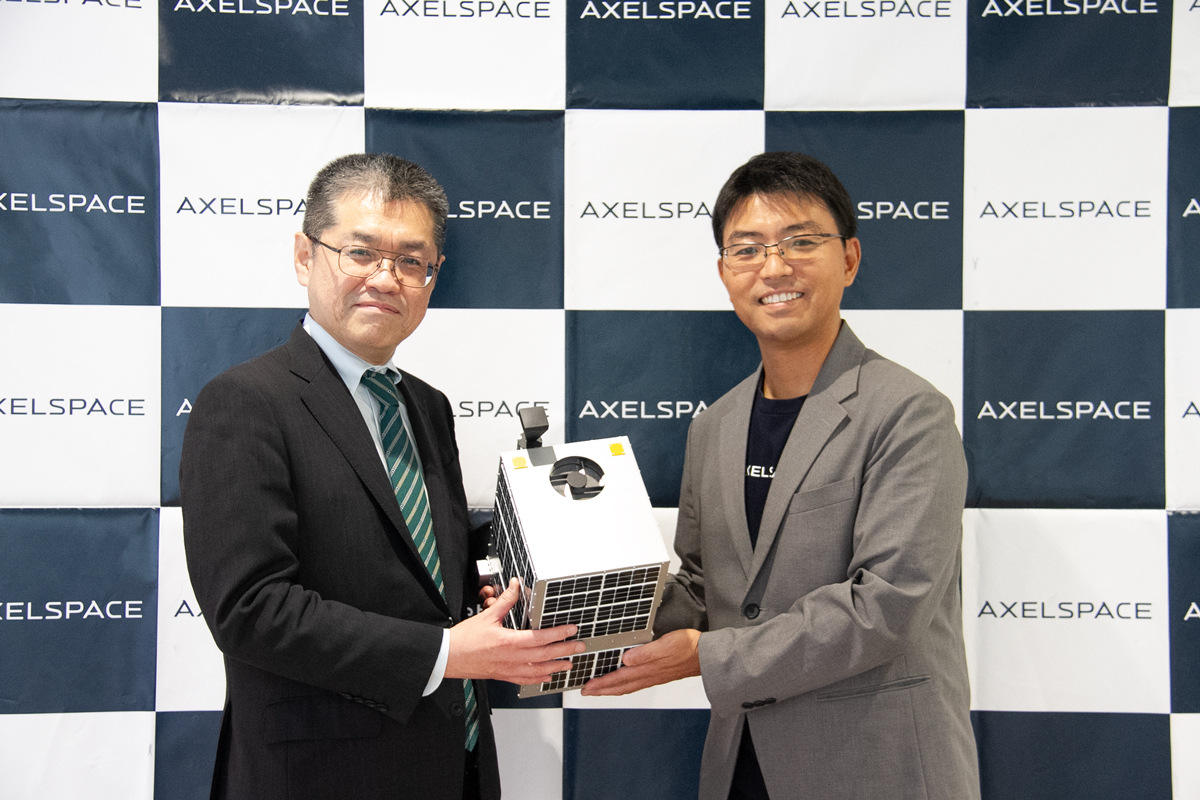
Axelspace Corporation (“Axelspace”), a leading developer and operator of microsatellites dedicated to realizing its vision of “Space within Your Reach,” announced the launch of a joint research project with Gakushuin University to develop strategies for space sustainability rulemaking.
Purpose of the Joint Research
The Green Spacecraft Standard 1.0 is Axelspace’s own space sustainability standard, established and published in 2023 with the goal of balancing the growth of space business with sustainability. Covering the entire satellite lifecycle — from mission planning and system design to manufacturing, operations, and disposal — the Standard sets requirements that exceed the levels outlined in guidelines published by governments and international organizations. The Standard has been applied to the development of the AxelLiner demonstration satellite “PYXIS” launched in 2024, “GRUS-3α,” the performance verification satellite launched in 2025, as well as seven “GRUS-3” satellites scheduled for launch from July 2026 onward. Through these development activities, Axelspace has accumulated practical insights into both the effectiveness of the Standard and the challenges associated with its implementation.
Nearly three years after its initial release, the global landscape surrounding space sustainability has continued to evolve. International research has advanced significantly, discussions within the United Nations Committee on Peaceful Uses of Outer Space (COPUOS) have deepened, and regulatory frameworks emerging through initiatives such as those of the U.S. Federal Communications Commission (FCC) and the EU Space Act have continued to mature. At the same time, standardization and assessment initiatives — including those led by the International Organization for Standardization (ISO), the Earth ∞ Space Sustainability Initiative (ESSI), and the Space Sustainability Rating (SSR) — have become increasingly active.
In response to these developments, Axelspace has launched a joint research project with Gakushuin University aimed at developing a revised version of the Green Spacecraft Standard and further advancing its approach to space sustainability.
This joint research places particular emphasis on three principles: feasibility, ensuring that the revised Standard can be responsibly and reliably implemented by a satellite developer and operator; effectiveness, ensuring that it reflects the latest developments in space sustainability research and results in meaningful measures; and leadership, ensuring that it goes beyond regulatory compliance to promote forward-looking practices that help lead the industry. Through this research, Axelspace and Gakushuin University aim to develop a revised standard that successfully balances these three principles and contributes to the sustainable growth of the space industry.

Scope of the Joint Research
This joint research project will examine the Green Spacecraft Standard, Axelspace’s space sustainability standard, in light of international developments in space sustainability research, regulation, and standardization. Based on these findings, the project will establish a revision policy for the standard from the perspectives of feasibility, effectiveness, and leadership. In addition, Axelspace and Gakushuin University will promote strategic engagement in international rulemaking activities through both the revision process and the outcomes of the project.
Gakushuin University will be responsible for investigating trends in space sustainability rulemaking, participating in relevant international activities, and developing the revision policy for the Green Spacecraft Standard. Axelspace, drawing on its experience as a developer and operator of microsatellites, will be responsible for evaluating and validating the technical feasibility of the proposed revision policy.
Through this project, Axelspace and Gakushuin University will develop rulemaking strategies that support the sustainable growth of the space industry while contributing to the creation of practical and effective sustainability frameworks informed by global developments in research, regulation, and standardization. Furthermore, through the continued advancement of the Green Spacecraft Standard and ongoing participation in international rulemaking initiatives, Axelspace and Gakushuin University aim to contribute to the realization of sustainable space business and its broader adoption across the industry.
For previous announcements related to the Green Spacecraft Standard, please see the link below.
Axelspace to Achieve Sustainable Space Business Settling Guidelines Covering the Entire Life Cycle of Satellites
Note: The development of a versatile satellite bus system for GRUS-3 is based on results obtained through the following projects subsidized by NEDO (New Energy and Industrial Technology Development Organization):
“Development and Demonstration of General-Purpose CubeSat and Microsatellite Buses” (FY2023-2026)
*This project was supported by the Ministry of Economy, Trade and Industry (FY2021-2022)
About Axelspace
Guided by its vision—“Space within Your Reach”—Axelspace has been at the forefront of microsatellite innovation since its founding in 2008. Leveraging cutting-edge expertise in microsatellite design, manufacturing, and on-orbit operations, the company is redefining how people and industries access space. Its flagship businesses, AxelLiner, which provides satellite development and operation services to help customers realize their space missions, and AxelGlobe, which delivers Earth observation data through Axelspace’s proprietary optical satellite constellation, are driving a new era of space utilization. Through these initiatives, Axelspace is shaping a future where space is accessible and within reach for everyone.
Axelspace Corporation
Headquarters: Tokyo, Japan
President and CEO: Yuya Nakamura
Founded: August 2008
https://www.axelspace.com/
Contact Information for Media
-
Axelspace Holdings Corporation
E-mail:pr@axelspace.com